
Commercial HVAC: A Complete Guide for Central Kansas Business Owners
What Is Commercial HVAC — and Why Does It Matter?
If you own or manage a commercial property in El Dorado, Hillsboro, or Emporia, your HVAC system isn’t just a comfort feature — it’s a business asset. A well-functioning commercial HVAC system keeps employees productive, customers comfortable, and equipment running within safe temperature ranges. When it fails, so does everything else.
Commercial HVAC is fundamentally different from residential. The systems are larger, more complex, and carry a significantly higher cost of failure. Understanding how they work — and knowing when to call a qualified contractor — can save you thousands in emergency repairs and lost revenue.
How Commercial HVAC Systems Work
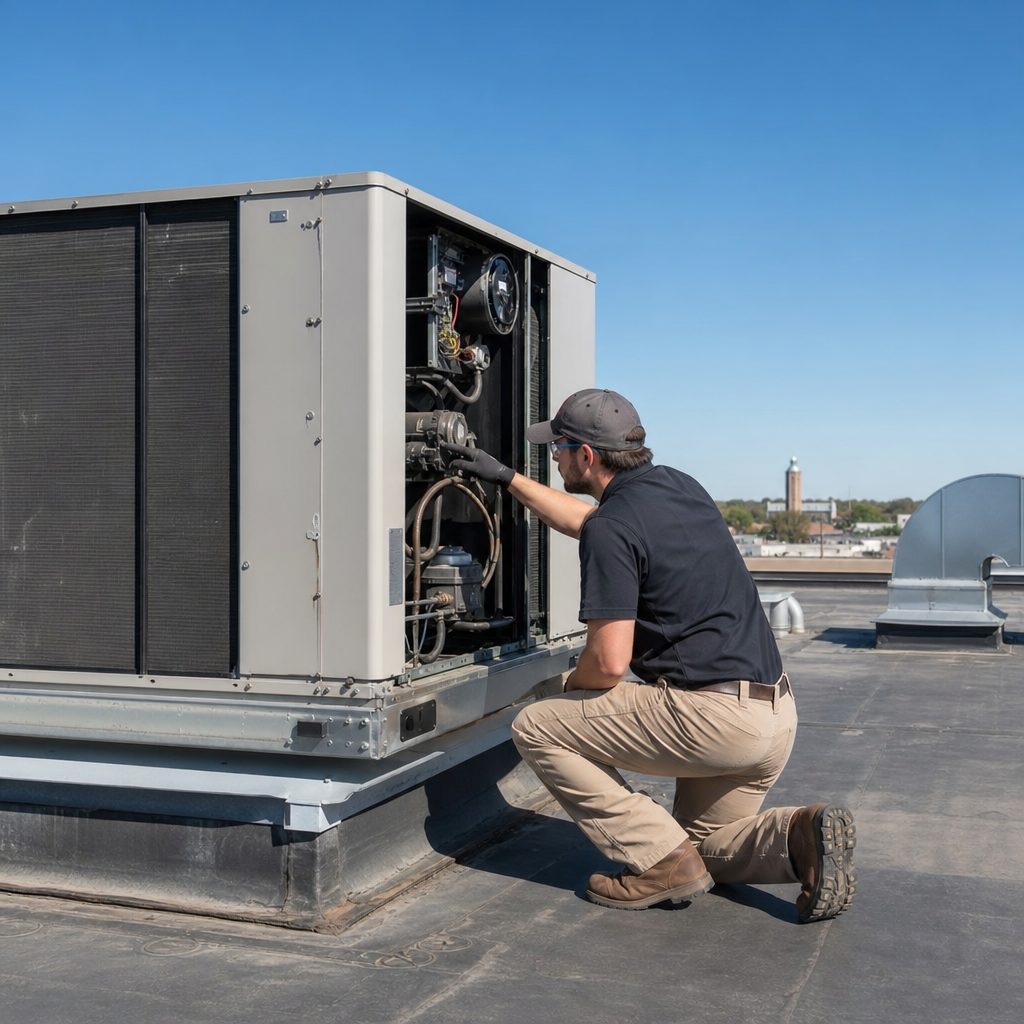
Commercial systems are designed to condition much larger spaces than a home. Instead of a single furnace and air handler, most commercial setups involve multiple zones, rooftop units (RTUs), air handlers, chillers, or boiler systems — all tied together through a network of ductwork and controls.
Here’s a quick breakdown of the main components:
- Rooftop Units (RTUs): The workhorse of most small-to-mid commercial buildings. Self-contained heating and cooling units mounted on the roof. Easy to service without disrupting interior operations.
- Split Systems: Similar to residential setups but scaled up. Indoor air handler + outdoor condenser. Common in smaller commercial spaces.
- Chillers and Boilers: Found in larger buildings. Chillers cool water that’s circulated to handle cooling loads; boilers heat water or steam for heating systems.
- Building Automation Systems (BAS): Smart controls that monitor and manage temperature, airflow, and energy use across multiple zones. Critical for energy efficiency in larger facilities.
Understanding what type of system you have is step one. Step two is knowing who to call when something goes wrong.
Common Commercial HVAC Problems
Most commercial HVAC failures don’t happen overnight — they build up over time through deferred maintenance, ignored warning signs, or systems simply reaching end of life.
Watch for these red flags:
- Uneven temperatures across zones — often a duct, damper, or control issue
- Rising utility bills with no clear cause — usually a sign of efficiency loss
- Frequent cycling — system turns on and off too often, indicating sizing or control problems
- Unusual sounds — banging, rattling, or squealing from an air handler or RTU needs immediate attention
- Poor air quality — musty smells, visible dust, or employee complaints about air quality point to filtration or coil issues
If any of these sound familiar, it’s worth getting a professional on-site before a minor issue becomes a system failure.
Commercial vs. Residential HVAC: Key Differences
| Factor | Residential | Commercial |
|—|—|—|
| System size | 1–5 tons | 5–100+ tons |
| Zoning | Single zone typical | Multi-zone standard |
| Installation location | Attic, basement, exterior | Rooftop, mechanical room |
| Maintenance frequency | Annual | Quarterly recommended |
| Failure impact | Family discomfort | Business disruption, liability |
Commercial systems demand more — and the consequences of neglect are steeper. A homeowner dealing with a failed AC faces a rough night. A restaurant owner or medical office faces far more serious problems.
Preventive Maintenance: The Smartest Investment You’ll Make
The single most effective way to protect your commercial HVAC investment is a structured preventive maintenance plan. Most manufacturers — and virtually every experienced contractor — recommend quarterly service for commercial systems.
A standard commercial PM visit typically includes:
- Filter inspection and replacement
- Coil cleaning (evaporator and condenser)
- Belt and bearing inspection
- Refrigerant level check
- Electrical connection tightening
- Thermostat and control calibration
- Drain pan and condensate line clearing
Skipping maintenance doesn’t save money — it just shifts the cost downstream into emergency service calls, premature equipment failure, and higher energy bills.
When to Repair vs. Replace Your Commercial System
This is the question every facility manager eventually faces. The general rule: if your system is more than 15 years old and repair costs exceed 50% of replacement cost, replacement is usually the smarter financial move.
Factors that push toward replacement:
- Refrigerant type (R-22 systems are increasingly costly to service)
- Repeated breakdowns in the same season
- Parts availability issues on older units
- Significant efficiency gap between your current system and modern equipment
A quality commercial system installed today will operate more efficiently, qualify for potential utility rebates, and come backed by manufacturer warranties that protect your investment for years.
Commercial HVAC in El Dorado, KS — Call Don’s
Don’s Heating & Air has been serving Central Kansas since 1959. That’s over 65 years of commercial and residential HVAC work across El Dorado, Hillsboro, Emporia, and the surrounding region. We service all makes and models, offer free on-site quotes, and back our installations with 10-year system warranties.
Whether you’re dealing with an RTU that won’t fire up on a January morning or you’re planning a full system replacement for a growing facility, we’ll give you a straight answer and a fair price.
Explore our commercial HVAC services or contact us for a free quote — same-day service is available across our service area.